

How can I help my child?
Dorset Education Advice Line
The Dorset Education Advice Line (DEAL) is a helpline provided by Dorset Council.
It is for parents, carers, and professionals who support children with emerging Special Educational Needs and Disabilities (SEND) or who are worried about a child's progress.
You can book an appointment with one of their SEND Family Workers. The contact details are:
- Free phone: 0800 1404041
- Operating Hours: Monday to Friday, 10:00am to 4:00pm
You can also usually book an appointment online via the Dorset Council website.
https://www.dorsetcouncil.gov.uk/dorset-education-advice-line-deal

Useful Information and Links
ADHD
ADHD Foundation - Understanding and Supporting your child's ADHD
Autism
The National Autistic Society is the largest UK charity for autistic people and their families.
Its goal is to create a society that works for autistic individuals by providing:
- Direct Services: Running specialist schools and adult support centers.
- Information: Operating the Autism Helpline for advice and guidance.
- Campaigning: Advocating for the rights and interests of autistic people nationwide.
ADAPT: After Diagnosis of Autism Parent Support Training
This resource is for parents and carers of children and young people who have a diagnosis of autism. It might also be helpful if your child is on the waiting list for an autism assessment.
The online course covers nineteen sections and looks at topics such as: language and communication, sensory differences, anxiety and masking. The course does not need to be completed in one go. If you leave and come back later or another day, it will remember where you got up to.
https://www.recoverycollegeonline.co.uk/courses/adapt/
Bedwetting
ERIC
ERIC is an acronym for Education and Resources for Improving Childhood Continence
ERIC offers a free helpline, expert advice on bedwetting and bowel issues (like constipation and soiling), and resources for families.
https://eric.org.uk/childrens-bladders/bedwetting/
Dyslexia
The British Dyslexia Association (BDA) is the leading national charity in the UK that campaigns to create a dyslexia-friendly society.
It provides support, advice, training, and resources for dyslexic people of all ages, their families, and professionals in education and employment. It aims to ensure dyslexic individuals can reach their full potential.
https://www.bdadyslexia.org.uk/
Dysgraphia
Dyspraxia UK is a specialist occupational therapy practice that offers professional assessment and support.
In addition to their clinical services, they provide valuable free informational resources on their website, including:
- A clear explanation of Dyspraxia (Developmental Co-ordination Difficulties).
- Age-specific symptom checklists.
- Guidance on next steps for those with concerns.
Foetal Alcohol Spectrum Disorder
Help for Foetal Alcohol Spectrum Disorder involves a combination of medical diagnosis, developmental therapies and community support. Since FASD is a lifelong, complex condition it is important to seek help if you have concerns. Start by speaking to a GP, Pediatrician, or Health Visitor about your concerns. They can give you further advice.
The NHS link below provides further details about FASD:
https://www.nhs.uk/conditions/fetal-alcohol-spectrum-disorder/
FASD Network UK is a specialist, not-for-profit organisation focused on Foetal Alcohol Spectrum Disorder (FASD) in the UK.
It provides information, support groups, and professional training,
Sensory Processing Difficulties
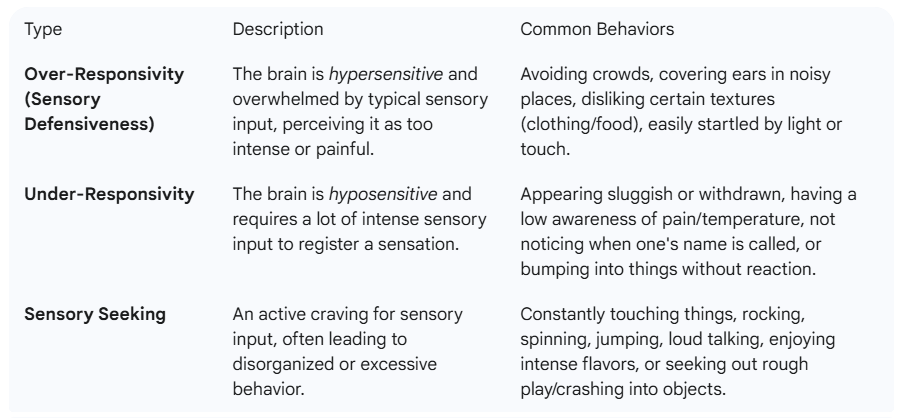
Sensory Processing Difficulties (often referred to as Sensory Processing Disorder or SPD) occur when a person's brain has trouble receiving, organising and responding appropriately to information that comes in through the senses.
This difficulty can affect any of the eight sensory systems, including the traditional five senses (sight, hearing, touch, taste, smell) as well as the vestibular (balance and movement), proprioceptive (body position/awareness), and interoceptive (internal body sensations like hunger or pain) systems.
Sensory processing difficulties are generally categorised by how the brain responds to the input:
Sensory processing issues frequently co-occur with neurodevelopmental conditions like Autism Spectrum Disorder (ASD) and Attention-Deficit/Hyperactivity Disorder (ADHD), but they can also occur independently.
Treatment usually involves Occupational Therapy using a Sensory Integration approach, which helps the individual's nervous system process and respond to sensory information in a more organised way.